



Reg-ent Participants Earn Nearly 3x the MIPS Payment Adjustment
Your MIPS Reporting, Simplified
Reg-ent streamlines MIPS reporting with visual score estimates, real-time guidance, and performance benchmarking, all through your dashboard.
Track your quality data over time and compare performance against fellow Reg-ent participants, clinicians within your practice, and national CMS Historical Benchmarks.
As a CMS-designated Qualified Clinical Data Registry (QCDR), Reg-ent accommodates reporting and submission for three MIPS performance categories: Quality, Promoting Interoperability, and Improvement Activities.
Understanding MIPS Performance Categories
MIPS scores are calculated across four performance categories. Reg-ent accommodates reporting and submission for three of them. Quality is weighted at 30%, Promoting Interoperability at 25%, Improvement Activities at 15%, and Cost at 30%.
Quality
Report on at least six quality measures, including one outcome or high-priority measure. Reg-ent supports all AAO-HNSF developed measures and ENT-specific QCDR measures exclusive to the registry. CMS takes your highest-scoring measures into consideration when calculating your Quality score.
Promoting Interoperability
Submit collected data for required measures across four objectives using Certified EHR Technology (CEHRT). New for 2024, data must be submitted for the same 180 continuous days during the calendar year. Exclusions may be claimed for certain measures.
Download 2025 MIPS Promoting Interoperability Quick Start Guide →
Improvement Activities
Implement 2–4 improvement activities to earn the maximum score of 40 points. Medium-weighted activities are worth 10 points and high-weighted activities worth 20, with points doubling for small, rural, or non-patient facing practices. Most activities require a 90-day continuous performance period.
Download 2025 MIPS Improvement Activities Quick Start Guide →
Cost
The Cost performance category is calculated directly by CMS after the performance year based on your Medicare claims data, no separate submission is required through Reg-ent. Cost score estimates are not available on the dashboard as this category is determined entirely by CMS.
Understanding Your MIPS Payment Adjustment
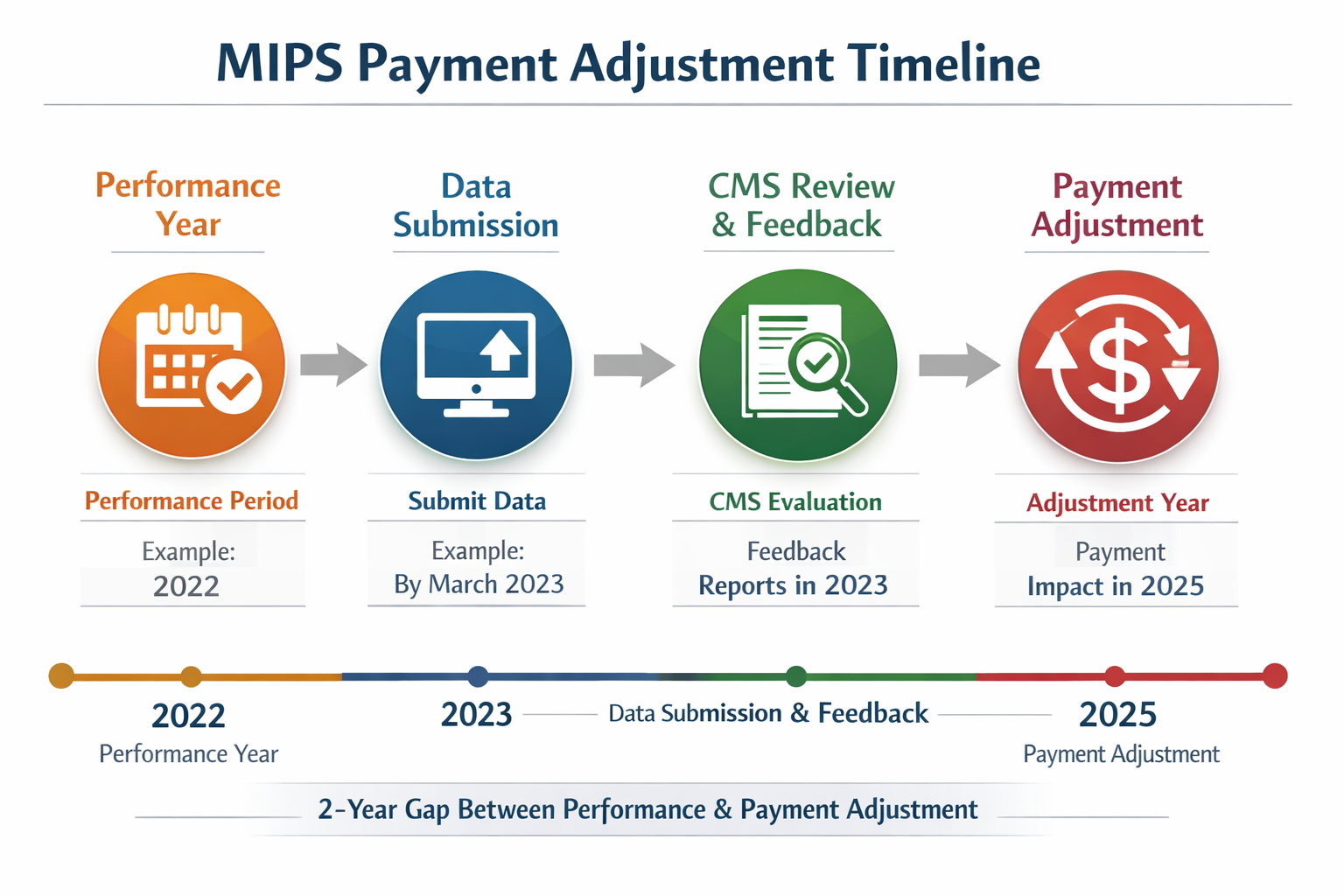
Payment adjustments are applied two years after the performance period. Data submitted for the 2026 performance year will determine your 2028 payment adjustment. Your final MIPS score determines whether your adjustment is positive, neutral, or negative, with 75 points required to avoid a penalty.
CMS makes a Final Score Preview available each June, giving practices an early look at their projected adjustment before it takes effect.
Tips for MIPS Success
Follow these best practices to maximize your MIPS score and avoid common reporting pitfalls.
Plan Your EHR Changes Early Communicate any plans to change electronic health records to the Reg-ent team as early as possible to avoid disruptions to your data flow.
Choose Meaningful Measures Select Quality and Improvement Activity measures that reflect your actual clinical practice — not just the easiest ones to report.
Determine Your Reporting Level Decide whether your practice will report individually or aggregate eligible providers as a group — this affects your overall score calculation.
Review Quality Benchmarks Review quality measure benchmarks before selecting measures to maximize your potential points and avoid measures where your performance may score lower.
Maximize Bonus Points Review opportunities for bonus points among Promoting Interoperability measures — these can meaningfully boost your final score.
Verify Your Clinician List Review your clinician and location list for completeness and accuracy before submission to avoid missing providers.
Review All Submitted Categories Before finalizing submission, review all performance categories to confirm data is complete and accurate across Quality, Promoting Interoperability, and Improvement Activities.
Frequently Asked Questions
Have questions about MIPS reporting through Reg-ent? Find answers to the most common questions below.
Who is required to participate in MIPS?
MIPS applies to a broad range of eligible clinician types including physicians (MD, DO, DDS, DMD, DPM, OD), physician assistants, nurse practitioners, certified nurse anesthetists, physical therapists, occupational therapists, clinical psychologists, qualified speech-language pathologists, qualified audiologists, registered dietitians, clinical social workers, and certified nurse-midwives.
You may be excluded from MIPS if you are newly enrolled in Medicare during the current performance year, participating in an Advanced Alternative Payment Model (APM), or do not exceed the low-volume threshold, which requires billing more than $90,000 for Part B covered professional services, providing care to more than 200 Medicare Part B patients, and furnishing more than 200 covered professional services to Part B Medicare patients. Clinicians who fall below the threshold may still choose to participate as a Voluntary Reporter (no payment adjustment) or Opt-In Reporter (eligible for payment adjustment).
Check your eligibility status at the QPP Participation Status webpage →
What quality measures are required to report?
There are no specific required measures. Practices must select at least six quality measures, including one outcome or high-priority measure. We encourage reporting all operational measures including AAO-HNSF developed measures. CMS takes your highest-scoring measures into consideration when determining your Quality score.
What is required for the Improvement Activities performance category?
Practices must implement 2–4 improvement activities to receive the maximum score of 40 points. Medium-weighted activities are worth 10 points and high-weighted activities are worth 20 points, with points doubling for small, rural, non-patient facing, or Health Professional Shortage Area (HPSA) practices. Most activities require a 90-day continuous performance period, and practices must retain documentation for six years following submission.
What is required for Promoting Interoperability?
Practices must submit collected data for required measures across four objectives using Certified EHR Technology (CEHRT) for the same 180 continuous days during the calendar year. Exclusions may be claimed for certain measures where applicable.
What happens if a clinician cannot complete one of the performance categories?
In some cases a performance category can be reweighted to 0% of the total score, typically requiring CMS approval for an exception or exclusion. Points from excluded categories are reassigned to remaining categories, with distribution depending on the number and type of categories submitted.
How do Reg-ent participants submit to MIPS?
Each February/March, Reg-ent participants receive an email notification that the MIPS Submission Module is open for the previous performance year. Practices are encouraged to schedule a submission call with the Reg-ent team, who will provide a checklist of steps to complete beforehand for a seamless submission process.
How much does MIPS reporting through Reg-ent cost?
Reg-ent charges a one-time application fee of $250 per provider, plus an annual subscription fee scaled to your practice size. MIPS reporting support is included as part of your participation, there are no additional reporting fees.